What is Pilates?

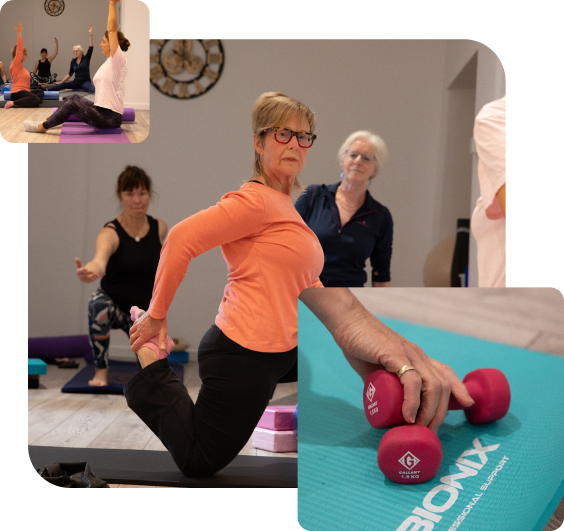
Pilates is a mat-based exercise that focuses on core activation (centring), breathing, and alignment. It helps us learn to control our body, reducing misalignment and the risk of muscle injury. This leads to improved balance and a greater awareness of how our body moves.

What to Bring

You will need these items for Pilates classes:

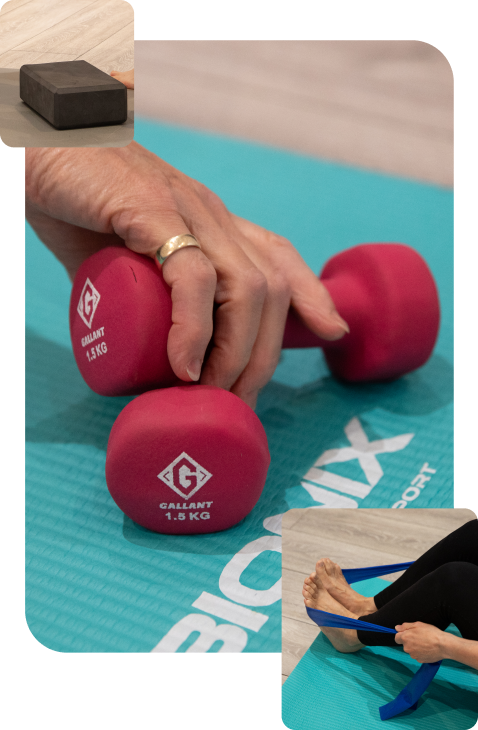
Pilates mat – thicker the better – the more expensive yoga mats are also suitable and a yoga mat (stops the Pilates mat from slipping)

2 Pilates blocks – similar to the yoga blocks as they are thinner, not bricks

Pilates elastic, physio band or scarf

Tennis ball or any similar

Small weights – scout the charity shops 1/2 kilo is sufficient

Small cushion

Long foam roller 90 cm – this depends on the class not required for Tuesday evening classes or beginners

Places to buy equipment

Mad Pilates
Argos
Core Balance
Amazon

Alignment

Aligning the head, shoulders, hips, knees and ankles on a stable base of a neutral spine and pelvis, provide the ability to move joints in their intended range of movement, (ROM), ie flexion, extension, lateral rotation and flexion, abduction, adduction, supination, pronation and circumduction from zero to 360 degrees depending on the limb and its limitations.  It is also necessary to consider the alignment of the smaller joints such as wrist, elbows, knees, ankles and feet too.  This awareness of alignment and stable base encourages correct muscle recruitment and prevents excessive load through the joints that causes dysfunction.

Alignment is the key to good stability both statically and dynamically.   Drawing a plumb line from the head to the toes is a helpful visualization of alignment whether in a start position of standing; lying; prone; four-point kneeling; side lying or upright on knees.

Breathing

Intra-abdominal pressure within the thoracic cavity is another important element of Pilates. As we exhale intra-abdominal pressure decreases and unless there is tone being exerted from the abdominals stability is reduced. To maintain dynamic stability, while moving in Pilates, synchronized thoracic breathing is used to laterally expand the ribcage while recruiting the abdominal muscles both on an inhalation and exhalation. Hence, breathing is vital in training core stability as it prioritizes the activation of stability muscles and is related to the challenge of the movement being performed.

Breathing also helps to relax a tense body and mind as well as enabling focus and concentration, a mindfulness. For example, breathing and having a clear mind provides an opportunity to recognize and release tense muscles so movement becomes flowing and effortless. Bodies become flexible in all areas and not overworked in over-flexible areas. Likewise, maintaining stability in over-mobile joints encourages the inflexible joints to be more active.

Centring

Stability and mobility also depend on our conscious awareness of the degree of pelvic floor engagement or centring used to achieve movement of the joint in the desired direction. A good analogy is that of a dimmer switch; turning recruitment up or down depending on our movement and its load. Therefore, muscular recruitment is related to the challenge of the movement being performed and likewise over-recruiting or bracing has a detrimental effect as it contributes to muscular tension and prohibits flowing movement.

Essentially, Pilates teaches us that mobility and stability are interdependent and interconnected leading the body to move effectively and efficiently. The eight principles of Pilates are the basis for each exercise to establish correct joint alignment, efficient muscle recruitment and breathing through core stability while being able to relax, concentrate, have flowing movement and most importantly facilitating functional movement.

Select a Location